موضوعات
آموزش و پرورش
ادبیات و زبان
پزشکی، دندانپزشکی و داروسازی
تاریخ و جغرافیا
داستان و رمان
دیگر
دین و فلسفه
روانشناسی
ریاضیات و آمار
سلامتی، تناسب اندام و رژیم غذایی
شیمی و پلیمر
علوم اجتماعی و حقوق
علوم زیستی و بیوتکنولوژی
فیزیک و نجوم
کامپیوتر و اینترنت
کتابهای کودکان و داستان
کسب و کار و اقتصاد
کشاورزی و دامپزشکی و غذا
معماری
مهندسی و فناوری
هنر و تئاتر
محصولات
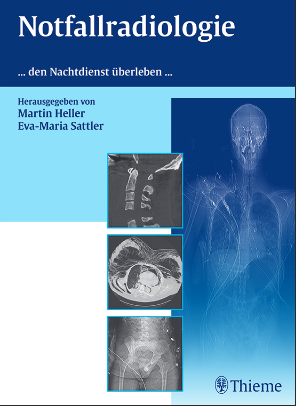
Notfallradiologie - Original PDF
نویسندگان: خلاصه: Vorwort Was ist das Schwerste von allem? Was Dir das Leichteste dünket: Mit den Augen zu sehn, was vor den Augen dir lieget. Johann Wolfgang von Goethe Die Nöte radiologischer Assistenzärzte, die – unterschied- lich ausgebildet – im Nachtdienst mit Fragen nach der Indikation, dem geeigneten Gerät, der Untersuchungs- technik und letztlich der Diagnose konfrontiert sind, ha- ben uns veranlasst, dieses Buch zu schreiben. Es hat nicht den Anspruch, ein Lehrbuch oder gar Handbuch zu er- setzen, es soll vielmehr ein Nachschlagewerk sein, in dem man schnell und zuverlässig die Informationen fin- det, die man dringlichst braucht. Zudem werden auch gängige Klassifikationen vermit- telt, die in der dringlichen Notsituation nicht sofort prä- sent sein müssen. Da aber jeder Untersuchung Befunde folgen, sollte auch hier eine Hilfestellung gegeben wer- den. Natürlich sind die Abläufe in allen Krankenhäusern sehr speziell, eine vergleichbare Vorgehensweise ist jedoch anzunehmen, da die Medizin als Notfallmedizin überall die gleichen Anforderungen an die Radiologie haben wird. Dieses Buch wendet sich an Assistenzärzte sämtlicher Fachrichtungen, vor allem Radiologen, die im Dienst mit radiologischen Untersuchungsstrategien, Untersuchun- gen und den daraus resultierenden Bildern konfrontiert werden, sowie an alle radiologisch Interessierten. Es sol- len die wichtigsten radiologischen Fragestellungen (Not- fälle) vermittelt werden. Da es ein sehr übersichtliches und kompaktes Buch ist, eignet es sich auch für Medizin- studenten zur Prüfungsvorbreitung. Ebenso können Ärzte an den Krankenhäusern, an denen kein radiologischer Dienst eingerichtet ist, aber Röntgen- und Ultraschallgeräte und Computertomografen zur Ver- fügung stehen, sicherlich von dem hier zusammengetra- genen Wissen profitieren. Wenn „der Nachtdienst“ und alle, die in der Notfallme- dizin tätig sind, dieses Buch mit Gewinn nutzen – dies ist unser Wunsch – hätte sich die Mühe gelohnt. Allen Mitarbeitern der Radiologie des UK-SH, Kiel und denen des Thieme Verlages danken wir sehr herzlich für ihre engagierte Unterstützung
MEDIA STUDIES THE BASICS SECOND EDITION - Original PDF
نویسندگان: خلاصه: INTRODUCTION TO THE SECOND EDITION Eight years on from the first edition of this book, any notion that updating it for a second edition would be quick or straightforward was dispensed with at the start of the process. We imagine that updating other books in this series might involve replacing some examples, refreshing the core concepts with new theories, perhaps reviewing the ‘shelf-life’ of some case studies. But for Media Studies, the subject never stands still, so this is more like a total system upgrade than a software update. For this reason, the second edition is a collaboration, to converge the perspective of the author of the original book with the experience and insight of the editor of MediaMagazine, also a teacher trainer in the subject. Maybe you have picked up this book because you’re starting a course in Media Studies (given the title, it’s a fair guess). Perhaps you are an English teacher diversifying into Media Studies. Or you could be a parent, wondering what Media Studies is really all about and whether your child should spend their time engaging with it. We will argue that in the era of social media platform capitalism and ‘fake news’, it’s more important than ever. If you are a Media student, the assumption will be that you’ve never studied it before – this is, after all, ‘The Basics’, although it might be a useful ‘refresher’ even if you have. All the way through, the emphasis will be on distinguishing between everyday media engagement and critical media literacy. Just by being alive in the contemporary ‘mediated’ world, we all respond actively to media – we never just ‘take it in’ without any thought or interpretation and more and more, we create it. Equally, the distinction between ou
The Lost World of Genesis One: Ancient Cosmology and the Origins Debate (The Lost World Series, Volume 2) - Original PDF
نویسندگان: خلاصه: In this astute mix of cultural critique and biblical studies, John H. Walton presents and defends twenty propositions supporting a literary and theological understanding of Genesis 1 within the context of the ancient Near Eastern world and unpacks its implications for our modern scientific understanding of origins. Ideal for students, professors, pastors and lay readers with an interest in the intelligent design controversy and creation-evolution debates, Walton's thoughtful analysis unpacks seldom appreciated aspects of the biblical text and sets Bible-believing scientists free to investigate the question of origins. The books in the Lost World Series follow the pattern set by Bible scholar John H. Walton, bringing a fresh, close reading of the Hebrew text and knowledge of ancient Near Eastern literature to an accessible discussion of the biblical topic at hand using a series of logic-based propositions.
Financial Innovations and Monetary Reform - Original PDF
نویسندگان: خلاصه: Many economics textbooks have explained the slow transformation from a sub- sistence economy to a barter economy, thus limited by the comparability of the objects or services exchanged. Although an improvement over the subsistence economy, the barter economy remains cumbersome and inefficient, as it requires the simultaneous acceptance of a transaction by both parties with physical delivery. The barter economy eventually gave way to a financial economy that was made possible by the issuance of money, a potentially universal intermediate means of payment, conducive to labor specialization and economic development.1 The Greek civilization and the emerging monetary system that resulted from it led international trade for centuries (from the fifth to the first century BC). Dur- ing this period of antiquity, the countries surrounding the Mediterranean became a world of commercial and industrial competition with the Greeks, the Phoenicians in the west and the Medes on the southeastern border as the players
The Coronavirus Pandemic and Inequality - Original PDF
نویسندگان: خلاصه: his book has been a long time in the making. It was first conceived in the summer of 2020 at which time few people expected a pandemic of the length we have experienced, dealing with a virus that is so efficient in morphing into ever more transmissible variants. Much of the world, including Europe, the United States, and Australia, now seems to have reached a point where COVID-19 is beginning to be regarded as endemic with occasional upticks, much like the annual influenza epidemics with which we have all learned to live. However, since we are not really out of the woods yet with respect to the COVID-19 pandemic, especially as vaccination rates in many parts of the world are well below where they need to be, this book can only be a provisional assessment of the effects and response to the coronavirus pandemic. It is an attempt to summarize and take stock of where many countries in the world stand as of October 2022
The Barcelona School of Ecological Economics and Political Ecology - Original PDF
نویسندگان: خلاصه: Joan (Juan) Martinez-Alier has been a pioneer in ecological economics. In addition to being one of the founding editors of the journal Ecological Economics, he con- tributed enormously to its theoretical development, as well as to uncovering and explaining its foundations in the history of economic thought. As if that were not enough, he served as president of the International Society for Ecological Economics, as professor and mentor of many European students in this new field at the University of Barcelona and as a social activist for ecological justice all over the world. Back in the mid-1960s, I read something he had written that impressed me, and I wrote him about it. Later while attending a conference in Barcelona, I managed to meet him briefly. Our friendship grew at early conferences on ecological economics in Stockholm and Barcelona and in Costa Rica. On a trip to the USA, he visited me at Louisiana State University, and later, I managed to get him as a consultant at the World Bank for a month, although neither his efforts nor mine had much influence on that institution. I regret that the Atlantic Ocean prevented more frequent and closer contact between us. Nevertheless, collegial friendship with Joan has been a great personal benefit to me, as it has also been to many others. His many intellec- tual and moral contributions are a gift to all ecological economists, and to the world. Felicidades y gracias, Joan!
Understanding Economic Transitions - Original PDF
نویسندگان: خلاصه: Around 1990, about a quarter of the world’s population lived in middle-income socialist economies and another quarter in high-income and middle-income cap- italist economies. The remainder lived in low-income economies with varying admixtures of planning, markets, and informal exchange institutions. Forty years later, the remaining outposts of socialism are Cuba and North Korea, while a few others (mainly in the former states of the Soviet Union) wallow in the no man’s land of neither functional capitalism nor socialism. The USSR sustained seven decades of statist socialism between 1922 and 1992, Central Eastern Europe (CE) and Southeastern Europe (SEE) for nearly five decades, and China for a little over three decades. By 2000, nearly all have systemically “transitioned” from a centrally-planned economy to some form of a decentrally organized market economy. How and why large parts of Europe, Eurasia, and East Asia transitioned out of the capitalist system in 1917–1952, how they managed to industrialize in non-market settings, and how and why they came back to the capitalist fold are questions comparative economic systems seek to address. Furthermore, this wrenching structural change entailed a concomitant political transition from a monoparty system to an illiberal multiparty system in formerly socialist Europe and the former Soviet Union (FSU). Comparative Economic Systems (CES) focuses on the workings of institu- tional economic mechanisms across economic systems and income levels. CES, at the macro-, meso-, and micro-levels, dwells on the two foundations of an economic system: ownership types for productive assets (state vs. private) and the degree of centralization of decision-making over resource allocation and income distribu- tion (plan vs. market). The conceptual entry points are incentives (known rewards or residual legatee rights) and the sources of discipline (bureaucratic-based or market-based competition). More broadly, Comparative Economics (CE), which is broader than CES, melds the study of economic systems with historical insti- tutionalism and development economics to explore the determinants of prosperity and inequality properties over time and across economic space within a given economic system
algrave Studies in Agricultural Economics and Food Policy - Original PDF
نویسندگان: خلاصه: The key questions which underpin the writing of this collective volume revolve around the concept of resilience and the contribution that this concept plays in the international development agenda, specifically in rela- tion to the issue of food security. Put simply: what does resilience bring that is relevant, useful and different from other previous or contem- porary concepts that have shaped the food security agenda, such as entitlements (Sen, 1981), vulnerability
Rethinking Economics Starting from the Commons Towards an Economics of Francesco - Original PDF
نویسندگان: خلاصه: What would happen if the economics courses taught in universities focused on the topic of the commons rather than of private goods? What if the former became the main subject of study and the latter the exception in the study of economic science? What if social business, rather than being considered a hybrid form, became the typical approach, with ethical and green finance taking over the financial sector? Is it possible to move away from the primacy of consumers to the preeminence of ethical consumers who express their daily preferences for an inclusive, sustainable, and worker-friendly economic system? These and other questions are the basis of this book, which aims to systematize the academic contribution to the development of the Economy of Francesco (henceforth EOF). EOF is a global movement of young (under 35 years) economists, entrepreneurs, and changemakers who, in 2019, answered Pope Francis’ call to gather in Assisi to rethink and change the global economy. The three pillars of the EOF are Pope Francis, with his social and economic magisterium; the Franciscan economic thought of the late Middle Ages, which is a source of precious knowledge with which to imagine a new economy; and the ideas of the young people thinking, working, and living a new economy. EOF is also a forum for youth-driven inclusive dialogue, stimulating a vibrant global change toward a new economic system, one that should serve everyone, regardless of income, gender, race, class, family, or background, and one in which everyone can thrive and feel included. To achieve this goal, EOF has been structured since the very beginning along 12 thematic “villages,” i.e., working sessions rooted in topics critical for today’s economy. Each thematic village contains a tension in its title, representing the already contemporary eco- nomic systems and the not-yet economy for which the movement advocates (i.e., Agriculture and Justice, Work and Care, Co2 of Inequalities, Women for Economy, Policies and Happiness, and many more)
Capitalism at a Crossroads A New Reset? - Original PDF
نویسندگان: خلاصه: Introduction Ali Ari Abstract Over the last three decades, the world economy has faced several complex and interrelated problems such as global climate change, food and energy scarcity, rising inequality, poverty, and more frequent and severe financial and economic crises. However, the capitalist system has been struggling to bring responses to those increasing problems and uncertainty. This has generated lively debates on the sustainability of the liberal capitalist economic system. Therefore, this book aims first to assess current problems of the world economy from a theoretical and empirical perspective, then to propose plausible answers from different points of view to restore the capitalist economic system. Keywords Capitalism · Sustainability · Growth · Climate change · Global warming · Agriculture · Energy · Inequality · Debt · Financial crises · Financialization · Poverty · Trade wars · COVID-19 · Political crises · Economic security · Artificial intelligence · Technological change · Great reset · Degrowth · Green deals · Solidarity economy · Balance of power · Smart citiesآیا کتاب مورد نظر هنوز بر روی سایت قرار نگرفته است؟ جای نگرانی نیست! کافی است بر روی گزینه سفارش کتاب کلیک کرده و درخواست خود را ثبت کنید. در کمتر از چند ساعت کتاب شما را آماده خواهیم کرد.