موضوعات
آموزش و پرورش
ادبیات و زبان
پزشکی، دندانپزشکی و داروسازی
تاریخ و جغرافیا
داستان و رمان
دیگر
دین و فلسفه
روانشناسی
ریاضیات و آمار
سلامتی، تناسب اندام و رژیم غذایی
شیمی و پلیمر
علوم اجتماعی و حقوق
علوم زیستی و بیوتکنولوژی
فیزیک و نجوم
کامپیوتر و اینترنت
کتابهای کودکان و داستان
کسب و کار و اقتصاد
کشاورزی و دامپزشکی و غذا
معماری
مهندسی و فناوری
هنر و تئاتر
محصولات
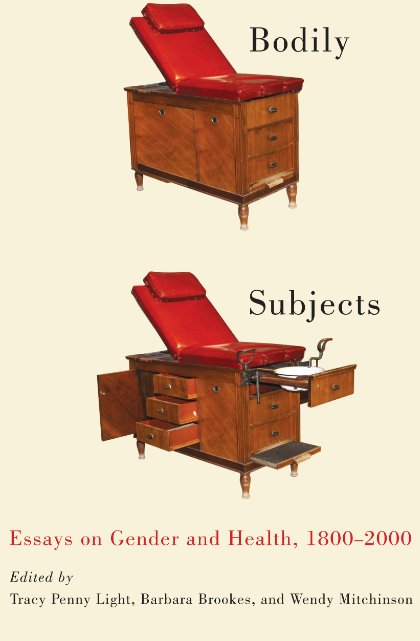
Bodily Subjects Essays on Gender and Health, 1800–2000 - PDF
نویسندگان: خلاصه: Constant good health is a chimera: the thing we all want, don’t notice when we have it, and mourn when we lose it. Being “healthy” is also something that women and men “do” in different ways. 1 The authors in Bodily Subjects all explore the historical entanglement between gender and health to expose how women and men “did” health in a variety of locations, from the nineteenth-century English Poor Law Union of Stourbridge, an early twentieth-century Aboriginal reserve in Queensland, Australia, to A I D S activists on the streets of Toronto in the 1990s. Our volume takes as its subject how gender is integral to the understanding of health and the way its meaning is embedded in cul- tural contexts connected to place and time. Our title reflects the way in which the body is both a subject of inquiry and a phenomenological experience. There is no “I” without a body and that body, Foucault has argued, is subject to regimes of power. 2 The title, Bodily Subjects, then, should be read in two ways. First, it re- fers to the embodied meanings of health for men and women and how these have expanded over time, from an able body signifying health in the nineteenth century to concepts of “well-being,” a psychological interpretation, which came to dominate health discourse in Western countries by the late twentieth century. Second, it refers to the way in which ill health turns individuals into subjects of the medical gaze. Medical expertise is brought to bear in diagnosing and treating indi- viduals in ways that are seen through the lens of gender
Comminution 1994 Proceedings of the 8th European Symposium on Comminution and 50th Event of the European Federation of Chemical Engineering, May 17-19, 1994 Stockholm, Swede - PDF
نویسندگان: خلاصه: Particle arrangements and confinements can be classified in the four groups (1) single particle situation, (2) one-particle layer, (3) particle bed confined closely or widely, and (4) ideal particle bed. Any confinement influences the stress distribution inside the bed due to the wall friction, and a complex stress field arises. The size-reduction effect is represented with the fraction of broken particles, the breakage function and the specific surface increases. The breakage functions of the particle bed comminution display as truncated logarithmic normal distributions. The stressing intensity can be quantified by the pressure, the stress field characteristics or the energy absorption. Although the stress field situation can differ extremely, the overall energy absorption has been proven to represent the stressing intensity very well in respect to the size-reduction. The transition from a close to a moderately wide confinement does not affect the size-reduction strongly. Steel balls inserted in a particle bed improve the breakage of coarse particles at a low intensity level. This advantage fades with increasing intensity and decreasing particle size.
Construction Management JumpStart The Best First Step Toward a Career in Construction Management (3rd Edition) - Original PDF
نویسندگان: خلاصه: Introduction Congratulations! You are about to embark on an adventure. This book is about the processes, the people, and the practices that we call construction management—a term and a profession that may be unfamiliar to many people. Construction, as most individuals understand it, is an activity or a series of activities that involves some craftspeople, building materials, tools, and equip- ment. But you will learn that there is a great deal more to it than that. If you think that construction is all about brawn and not much about brains, then you probably haven’t been paying very close attention to what has been going on in the built environment in the past several decades. Buildings today can be very complicated, and the building process has become extremely demanding. It takes savvy professional talent to orchestrate all of the means and methods needed to accomplish the building challenge. This book’s focus is not on construction per se. Its focus is on the construction process and those individuals who manage that process. Construction manage- ment involves the organization, coordination, and strategic effort applied to the construction activities and the numerous resources needed to achieve the building objective. Construction management combines both the art and science of building technology along with the essential principles of business, management, computer technology, and leadership. Construction management as a profession is a relatively new concept, which may explain why you have not heard of it before. Up until the 1960s, the management tasks associated with large construction projects were typically handled by civil engineers. But in 1965, faculty from nine universities gathered in Florida to form the Associated Schools of Construction. What started as a movement to upgrade the status of construction education at universities evolved into a standardized construction management curriculum leading to an exciting new career choice, one for which there was increasing demand. Men and women who love the idea of transforming a lifeless set of plans and specifications into something real—a single-family home, a high-rise office building, a biotech facility, a super highway, or a magnificent suspension bridge—had found an educational program that provided both the academic course work and the practical management tools needed to plan, organize, and coordinate the increas- ingly complex construction process. If you are one of the many individuals who desire the intellectual challenges of architecture, engineering, technology, and business, yet long to be outside in the thick of things, getting your hands dirty and ultimately producing a tangible result—something of lasting value—then construction management might just be the ticket for you
Darwin: Portrait of a Genius by Paul Johnson - Epub + Converted PDF
نویسندگان: خلاصه: All his life, Charles Darwin believed that inheritance was much more important in shaping a man or woman than education or environment. Nature rather than nurture was formative, in his view. Though he knew nothing of the science of genetics, and never used the word gene, which is first recorded in English in 1911, more than a quarter- century after his death, he is a classic case of genetic inheritance. Indeed, two of his grandparents and his father can reasonably be classified as geniuses. His paternal grandfather, Erasmus Darwin (1731–1802) came from an old family of modest landowners. After Cambridge, he trained as a doctor in Edinburgh, and then practiced in Litchfield, Dr. Johnson’s town (they did not get on). He was successful and had many patients, easily earning £1,000 a year, a handsome income then. News of his skill reached the ears of George III, who invited him to come to London as the royal doctor. But Dr. Darwin declined. The Hanoverian royals were slow at paying their doctors. In any case, Darwin was happy as he was, combining a busy provincial practice with poetry and science. The symbol of this dualism was his coach, which he designed himself. It was fitted up with a writing desk, a skylight, and a portion of his library, so that he could carry on his intellectual pursuits while going on his daily round of professional calls.
Dialogues and Short Stories in Turkish: read, listen, practice and improve your Turkish - PDF
نویسندگان: خلاصه: Dialogues and Short Stories in Turkish is the first book of the Türkçeyi Seviyorum (I Love Turkish) series. There are 15 texts in this book. These texts were written and then recorded specifically to support learners on the A1-A2 beginner level to improve their Turkish language skills and practice with fun reading, listening, writing and quiz activities. If you are a beginner plus, you can still benefit from this book in terms of improving your reading and listening skills and both reviewing and learning more vocabulary. That’s why it has been leveled as A1-A2+. Dialogues and Short Stories in Turkish is a self-improvement and self-practice book. It shouldn’t be considered as a teach yourself book. You don’t need to follow the sections step by step. Feel free to skip around the texts. You might be able to enjoy understanding all the vocabulary and grammar structures in this book but if you had any trouble understanding some of those depending on your past learning experiences, please use the grammar appendix and the glossary to gain a fruitful use of the book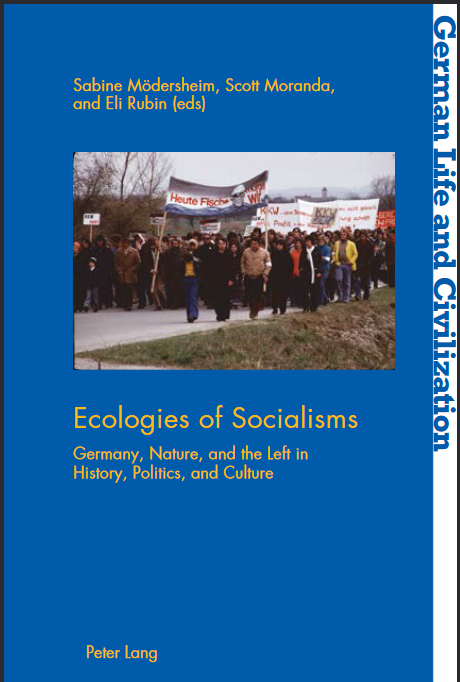
Ecologies of Socialisms - Original PDF
نویسندگان: خلاصه: Eli Rubin and Scott Moranda Introduction Is Germany the “Greenest nation” as Frank Uekötter has provocatively asked?1 Forget the Berlin Wall, forget the Cold War, World War II, the Nazis, the Holocaust, the Kaiserreich, and forget the storied history of the Social Democratic Party – the SPD. Germany is now the nation of separated trash, solar panels and wind power. The only Wende people talk about now, in relation to Germany, is the Energiewende. And perhaps, that is part of the point. The Energiewende provides for a national identity that generates warm, positive press and seemingly avoids the more divisive and troubling aspects of past markers of Germanness. Even if the reality of the “greenest nation” is more complicated, it is undeniable that Germany has been at the center of the global history of environmentalism. Scientific conservation had deep roots among the forest- ers, urban planners, and other technical experts of Wilhelmine Germany who had outsized influence on Progressive reformers in the United States and British civil servants across their Empire.2 German-speakers also shaped Romanticism, ecology, and notions of holistic interconnectedness, most importantly in the figure of Alexander von Humboldt, whose Kosmos had a global influence.
Epistemology Modalized by Kelly Becker - Original PDF
نویسندگان: خلاصه: 1 Introduction: Externalism and modalism Recent developments in epistemology, and in philosophy more generally, provide a promising foundation for an answer to a very old question: What is knowledge? The question stymied Plato in the Theaetetus, from which the traditional tripartite analysis of knowledge as justified true belief derives. It received fresh attention when Edmund Gettier showed that the three conditions of the traditional analysis were not jointly sufficient for knowledge. Subsequent attempts to repair the analysis of knowledge aimed (1) to amend the notion of justification to avoid the Gettier problem; (2) to add a fourth condition, for instance that there are no defeaters to one’s justification; or (3) to replace justification with some other condition that captures the requisite link between belief and truth constitutive of knowledge. 1 The uniqueness of the third strategy is not clearly defined because one could easily argue that, whatever the necessary link between belief and truth turns out to be, it just is justification. Nonetheless, I see myself as pursuing this approach because the very term ‘‘justification’’ is all too pregnant with associated notions that I believe are not essential to knowledge, and work- ing toward an account that explicitly involves justification as a necessary condition can lead us away from a proper understanding of knowledge. (A specific instance of this problem arises in Chapter 2.) Unencumbered by the requirement to explicate ‘‘justification,’’ we can inquire into the requisite belief-truth link constitutive of knowledge by testing proposals for that link against our intuitions concerning whether an agent actually knows in parti- cular cases. If we find that a correct or, at least, working account of that link does not capture the traditional conception of justification, then so be it. 2 Our topic, then, is propositional knowledge: knowledge that p for some arbitrary proposition p. I will not claim that all other forms of knowledge, for instance, knowledge by acquaintance, knowledge of one’s own phenom- enological states, and know-how, are reducible to propositional knowledge, and so do not intend to give an account of knowledge in general. This only slightly diminishes the importance of an account of propositional knowl- edge, since it is through sentences and the propositions they express that we think and talk about the world. It would be a significant advance in our understanding if we had a plausible theory of such knowledge
Evolution 2.0: Breaking the Deadlock Between Darwin and Design - Epub + Converted PDF
نویسندگان: خلاصه: This product is estimated to be delivered within 2-3 weeks from the dispatch date. In the ongoing debate about evolution, science and faith face off. But the truth is both sides are right and wrong. In one corner: Atheists like Richard Dawkins, Daniel Dennett, and Jerry Coyne. They insist evolution happens by blind random accident. Their devout adherence to Neo-Darwinism omits the latest science, glossing over crucial questions and fascinating details. In the other corner: Intelligent Design advocates like William Dembski, Stephen Meyer, and Michael Behe. Many defy scientific consensus, maintaining that evolution is a fraud and rejecting common ancestry outright. There is a third way. Evolution 2.0 proves that, while evolution is not a hoax, neither is it random nor accidental. Changes are targeted, adaptive, and aware. You’ll discover: How organisms re-engineer their genetic destiny in real time Amazing systems living things use to re-design themselves Every cell is armed with machinery for editing its own DNA The five amazing tools organisms use to alter their genetics 70 years of scientific discoveries-of which the public has heard virtually nothing! Perry Marshall approached evolution with skepticism for religious reasons. As an engineer, he rejected the concept of organisms randomly evolving. But an epiphany-that DNA is code, much like data in our digital age-sparked a 10-year journey of in-depth research into more than 70 years of under-reported evolutionary science. This led to a new understanding of evolution-an evolution 2.0 that not only furthers technology and medicine, but fuels our sense of wonder at life itself. This book will open your eyes and transform your thinking about evolution and God. You’ll gain a deeper appreciation for our place in the universe. You’ll see the world around you as you’ve never seen it before. Evolution 2.0 pinpoints the central mystery of biology, offering a multimillion dollar technology prize at naturalcode.org to the first person who can solve it.
Exporting the European Convention on Human Rights - Original PDF
نویسندگان: خلاصه: As for the right to protect one’s private and family life, as enshrined in Article 8 ECHR, the CJEU provided the very first explicit reference to the ECHR in Rutili v Minister for the Interior�53 In casu, the Convention was conceived as a source of inspiration as well as a human rights standard for determining the legality and legitimacy of the acts of Member States applying EU law. Therefore, the CJEU applied the ECHR as a clear human rights standard to also interpret the ‘public policy’ exception to the free movement of workers, justifying Member States to restrict this freedom only to the extent authorised by the ECHR, that is, when it is necessary for the protection of the interests of national security or public safety ‘in a democratic society’.54 This landmark case illustrates how the CJEU has progres- sively shaped its autonomous human rights case law, inspired, though, by the ECHR and by the common constitutional traditions of EU Member States.55 The Luxembourg Court established a much broader human rights review over their actions and paved the way for a much clearer reference to the Convention’s provi- sions as a material source of EU legal order, rather than a source of inspiration.56 Nonetheless, besides the consensus in this field, conflicts and inconsistencies between the two European jurisdictions have not been sidestepped. The main preoccupation of the following section is thus to unveil the extent to which the CJEU has directly referred to ECHR norms to protect private and family life57 with regard to the most controversial fields of data protection and migration/ asylum cases.
From Darwin to Derrida Selfish Genes, Social Selves, and the Meanings of Life - Epub + Converted PDF
نویسندگان: خلاصه: Evolutionary theory can be a nasty business. Perhaps it has something to say about human nature. Most scientifically respectable evolutionary theories wear garments of math. I think of mathematical models as disciplined metaphors. We use x to represent something in the world, say slugs, and y to represent something else, say lettuces, then we analyze the relation of x to y using mathematics. We imagine that slugs and lettuces behave like x and y in the model, and then we use how x and y behave in the model to understand how slugs and lettuces behave in the world. Nobody can argue with mathematical models—that is one of the points of using mathematics—but there can be endless arguments about what you put into a model and what you leave out, and endless arguments about what the model means, because metaphors can be interpreted in many ways. I am not criticizing the use of metaphors—far from it, they are essential. All that we know about the world is metaphor. Our perceptions are a virtual reality, not the thing in itself but something that stands in the place of the thing. Phenomena are metaphors used to comprehend things. Don’t worry, this book contains almost no mathematics; but, if you don’t like metaphor, then this is probably a good time to return the book and ask for a refund.آیا کتاب مورد نظر هنوز بر روی سایت قرار نگرفته است؟ جای نگرانی نیست! کافی است بر روی گزینه سفارش کتاب کلیک کرده و درخواست خود را ثبت کنید. در کمتر از چند ساعت کتاب شما را آماده خواهیم کرد.