موضوعات
آموزش و پرورش
ادبیات و زبان
پزشکی، دندانپزشکی و داروسازی
تاریخ و جغرافیا
داستان و رمان
دیگر
دین و فلسفه
روانشناسی
ریاضیات و آمار
سلامتی، تناسب اندام و رژیم غذایی
شیمی و پلیمر
علوم اجتماعی و حقوق
علوم زیستی و بیوتکنولوژی
فیزیک و نجوم
کامپیوتر و اینترنت
کتابهای کودکان و داستان
کسب و کار و اقتصاد
کشاورزی و دامپزشکی و غذا
معماری
مهندسی و فناوری
هنر و تئاتر
محصولات
New Perspectives and Paradigms in Applied Economics and Business - Original PDF
نویسندگان: خلاصه: Preface Due to the global situation regarding the COVID-19 pandemic, the 2022 6th Inter- national Conference on Applied Economics and Business (ICAEB 2022), which was planned to be held in Stockholm, Sweden, during August 24–26, was held as a hybrid conference during the same time period. The decision to hold the conference in hybrid mode was made in compliance with many restrictions and regulations that were imposed by countries around the globe. Such restrictions were made to mini- mize the risk of people contracting or spreading the COVID-19 through physical contact
The Profit Magic of Stock Transaction Timing - Original PDF
نویسندگان: خلاصه: Can a $10,000 investment yield $1,000,000 in a year? In five years? If so, what is the risk involved? These are the kinds of questions to which this work is addressed. Such fantastic results are possible in the stock market. Individual issues fluctuate widely enough and often enough to permit this and more. Techniques are presented here that put an average yield on invested capital of 10% per month, well within the realm of possibility. Compounding profits at this rate, such a yield can return $1,000,000 on a $10,000 investment within 50 months. An actual trading experiment will be described using these principles which produced an 8.9% yield per transaction--every 9.7 days. Such a yield, if continued, compounds $10,000 to $1,000,000 in 15 months. If such results can be attained in the market -- why isn't everyone doing it? The answer is complex, but the elements are simple: effort, knowledge and psychological barriers. Any goal this worthwhile requires time and effort. Most investors, amateur and professional do not have the kind of analytical background needed to shear through rumour, opinion, and adage to get at the basis of why stock prices change. And finally, even with knowledge in hand, many investors lack training in the emotion-logic balance required for success. Nevertheless, all of these obstacles can be overcome. It is the purpose of this book to provide you with the essentials. The results are yours if you care to apply yourself with sufficient intensity. Investment operations will be presented here in a deliberately unorthodox manner. We will turn our backs firmly on all cliches, adages, and market lore that will not withstand critical scrutiny. Where necessary, we will not hesitate to form new ones that do fit the facts. You will find here that the big money in investing stems from the principle of "profit compounding:---of short-term trades. It is further shown that this potential cannot be exploited in an optimum manner without a large improvement in transaction-timing capability that cannot be achieved using traditional investment methods. You will be exposed to: a concept of profit maximization; a model of stock price motion with prediction implications; an explanation of why chart patterns form---and how to use this knowledge to your profit; step-by-step methods for using the price-motion model to generate definite "wait," "buy," "hold," "sell," "sell short," "cover short," and "protect profit" signals; an explanation of why moving averages work and how to design your own for use in transaction timing; a complete trading method: how to select issues, how to analyse them for action signals, and how to improve your chances of turning and keeping a profit; the extent to which you should be concerned by chance factors, whether or not you should sell in case of war or financial crisis; the reasons why psychological considerations can affect your profits and what you can do about it; an introduction to numerical analysis and spectral analysis, upon which the results on the book are based. The problems of trading techniques and methods are dealt with directly. Enough methods and references are included to permit further research if desired.
Handbook of Hope Theory, Measures, & Applications - PDF
نویسندگان: خلاصه: This Handbook of Hope simply would not have happened without a small army of graduate students who, over the past decade, have come into my office one by one and suggested yetanother angle from which we could view hope. In that sense, what has come to be called hope theory has been like a gemstone that, when held to the light, sends shimmers of ideas about yet other possible implications or experiments. I have produced previous theories about reactions to personal feedback, uniqueness seeking, excuse making, and reality negotiation, hue none of chose have continued co produce the sufficiently intriguing questions to get me revved up for yet another experiment. Hope theory has been a great energizer at a time in my life when I have needed it. For the past seven years I have had a severe, unrelenting, and undiagnosed chest pain that is with me from my fim waking moments to the time th.at I slip off into sleep. Although I have been taking powerful pain killers, I think that none of those pills matches the positive effects of my getting lost in theory and research and work- ing with my students. At age 55 (by the time this book is published), I still enjoy the theory and bench science to the same degree that I did as a brand new 27-year- old assistant professor here at Kansas. And so, I have much for which to be th:.ink- ful.
The Political Economy of Reforms and the Remaking of the Proletarian Class in China, 1980s–2010s - Original PDF
نویسندگان: خلاصه: CHAPTER 1 Introduction On 1 July 2021, Xi Jinping stated in his speech at the conference of cele- bration of the one-hundredth anniversary of the founding of the Chinese Communist Party (CCP) that the Reform and Opening Up and socialist modernisation is one of the greatest achievements of the CCP.1 In the speech, he said the People’s Republic of China (PRC) “achieved the implementation from the highly centralised planned economic system to the dynamic system of a socialist market economy” (shixian le cong gaodu jizhong de jihua jingji tizhi dao chongman huoli de shehui zhuyi shichang jingji tizhi). Raised up in 1978, the Reform and Opening Up (gaige kaifang ) has lasted for 44 years now, as has the state’s reform of the economic system. As Xi mentioned in his speech, due to the reform of the economic system, China has become the second-largest economy in the world
Geography of Happiness A Spatial Analysis of Subjective Well-Being - Original PDF
نویسندگان: خلاصه: Recent advances in spatial analysis have led to a growing interest in applying geocomputation methods to complex issues (Du et al., 2020), often defined over large datasets framing socioeconomic variables (Ekbia et al., 2015) and the natural environment (Bryan et al., 2011). Much of this work has been carried out to optimize decision-making and lead to a better quality of life, economic growth and social stability (Higgins et al., 2014; Rosu et al., 2015; Ahlfeldt et al., 2020). Thanks to the advances of computational power, spatial analysis has reached a new stage, where nonlinear modelling approaches combined with stochastic modelling allow for a better understanding of the geographical environment (Silva et al., 2020) and there- fore foster more accurate decision-making (Carver, 2019). This decision-making has focused predominantly on sustainable development, leading to better life quality, where spatial information on the natural environment has brought a key role, partic- ularly in ecology, to understand the present and offer a more sustainable future. From an anthropocentric perspective, wellbeing is the relation of humankind’s social, economic, and environmental stability, maximizing the opportunities for sustainable development while leading to better life quality. This holistic approach of wellbeing closely rem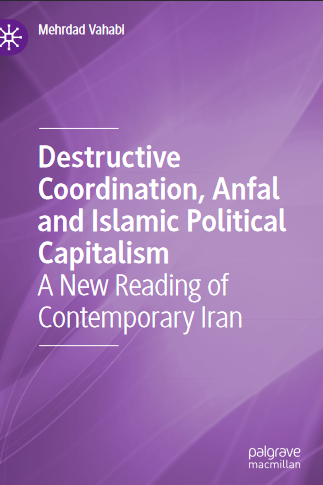
Destructive Coordination, Anfal and Islamic Political Capitalism A New Reading of Contemporary Iran - Original PDF
نویسندگان: خلاصه: xi The term Anfal in the title of this book is not familiar for the general readership and its meaning cannot be easily understood by referring to English dictionaries. What is Anfal? If you launch an internet search on Anfal, you will encounter two main strands of literature. The first one relates to the Kurdish genocide by Saddam’s regime in the late eighties, and the second is about the eight Surah (chapter) of the Koran known as ‘Al-Anfal’. As Kurdistan regional government has aptly underlined, in Kurdish society, the word Anfal has come to represent the entire genocide over decades. Anfal was the term used by Saddam Hossein to describe a series of eight military campaigns conducted by the Iraqi government against rural Kurdish communities in Iraq, which lasted from February 23 to September 6, 1988.1 The campaign took its name from Surah al-Anfal in the Koran. Al-Anfal literally means the spoils of war (bounties) and was used to describe the military campaign of extermination and looting commanded by Ali Hassan al-Majid, the cousin of Saddam Hossein. As President of Iraq, Saddam Hossein frequently used religious language when describing the actions of his Ba’athist regime (see Johns, 2006), portraying Arabs as true defenders of Islam and Kurds as infidels.2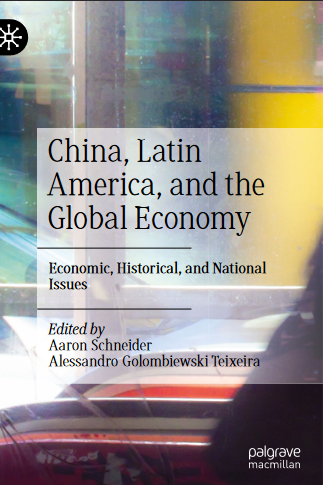
China, Latin America, and the Global Economy Economic, Historical, and National Issues - Original PDF
نویسندگان: خلاصه: CHAPTER 1 Introduction Alessandro Golombiewski Teixeira and Aaron Schneider China has sought to occupy a more prominent global position without upsetting existing international relationships. This has been especially true in Latin America, where the US continues to dominate regional relations as a result of geographic proximity and historical engagement, among other reasons. Still, China is already the top trading partner or among the top trading partners for every country in the region, espe- cially as Chinese growth outpaced the West in the aftermath of the 2008 financial crisis, and China has continued to act as the motor for the international economy after the onset of the 2019 pandemic. Increas- ingly, Chinese capital rivals Western-dominated multilateral, bilateral, and private lenders and investors in the region. To make sense of Chinese “going out” and the response from Latin America, the current projec
Fundamentals_of_Computer_Graphics - Original PDF
نویسندگان: خلاصه: Preface This edition of Fundamentals of Computer Graphics includes substantial rewrites of the material on shading, light reflection, and path tracing, as well as many corrections throughout. This book now provides a better introduction to the tech- niques that go by the names of physics-based materials and physics-based ren- dering and are becoming predominant in actual practice. This material is now better integrated, and we think this book maps well to the way many instructors are organizing graphics courses at present. The organization of this book remains substantially similar to the fourth edi- tion. As we have revised this book over the years, we have endeavored to retain the informal, intuitive style of presentation that characterizes the earlier editions, while at the same time improving consistency, precision, and completeness. We hope the reader will find the result is an appealing platform for a variety of courses in computer graphics. About the Cover The cover image is from Tiger in the Water by J. W. Baker (brushed and air- brushed acrylic on canvas, 16” by 20”, www.jwbart.com). The subject of a tiger is a reference to a wonderful talk given by Alain Fournier (1943–2000) at a workshop at Cornell University in 1998. His talk was an evoca- tive verbal description of the movements of a tiger. He summarized his point: Even though modelling and rendering in computer graphics have been improved tremendously in the past 35 years, we are still not at the point where we can model automatically a tiger swimming in the river in all its glorious details. By automatically I mean in a way that does not need careful manual tweaking by an artist/expert. The bad news is that we have still a long way to go. The good news is that we have still a long way to go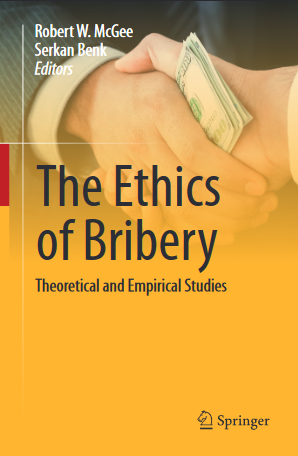
The Ethics of Bribery Theoretical and Empirical Studies - Original PDF
نویسندگان: خلاصه: he present study is part of a much larger study that examines the ethics of bribery and tax evasion. The bribery studies consist (so far) of two books (McGee & Benk, 2023a; McGee & Benk, 2023y) and many articles and book chapters. Summaries of 28 studies (McGee, 2023a), 24 studies (McGee, 2023b), 44 studies (McGee, 2022a), and 80+ studies (McGee, 2022b) are also available. The tax evasion studies started in 1994 (McGee, 1994) and picked up speed in 1998 when the first book in the tax evasion series was published (McGee, 1998). The second book in the series was published in 2012 (McGee, 2012a). Two more books were recently added to the tax evasion collection (McGee & Shopovski, 2023a, b). Many articles and book chapters on the ethics of tax evasion have been published over the years. Summaries of many of them are available. There are sum- maries of 49 studies that used a survey template that usually consisted of 18 state- ments starting with the phrase, “Tax evasion is ethical if ...” (McGee, 2012b). Another study summarized 23 studies that used World Values Survey data (McGee, 2012c). Other studies summarize 3 studies (McGee, 2012d), 21 studies (McGee, 2022c), 35 studies (McGee, 2022d), 60+ surveys (McGee, 2022e), 70+ theoretical and empirical studies (McGee, 2022f), 100+ studies (McGee, 2022g), 80+ studies (McGee, 2022h), 34+ studies (McGee, 2022i), and 44+ studies (McGee, 2022j). Part II of the book addresses attitudes toward bribery from different religious perspectives. The first chapter in this section provides a comparative study of reli- gious attitudes toward bribery (McGee et al., 2023a). There are also chapters that report on attitudes of Christians (McGee et al., 2023b), Muslims (McGee et al.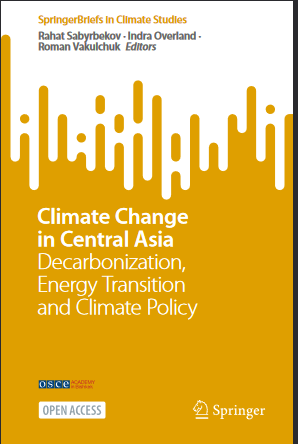
Climate Change in Central Asia Decarbonization, Energy Transition and Climate Policy - Original PDF
نویسندگان: خلاصه: This chapter provides a broad introduction to the impact of climate change in Central Asia, a region that has been experiencing a greater rise in temperatures than other parts of the world. The chapter shows how climate change represents a significant threat to Central Asia, exacerbating existing economic and environmental challenges and fueling regional tensions over resource management. Inefficient water resource management at the national level and limited regional collaboration on the management of water resources, coupled with state capacities that remain insuffi- cient to tackle climate change impacts, compound water-related tensions between the countries in the region. The chapter also shows how decarbonisation efforts in Central Asia are still in their early stages, with coal remaining a primary source of energy. Although the Central Asian countries have announced decarbonisation targets and adopted green economy strategies and programmes to reduce green- house gas emissions, a large-scale clean energy transition remains unlikely in the short term. The chapter concludes by identifying a lack of scholarship on climate change in Central Asia, which limits the development of a coherent approach to climate change mitigation and adaptation and evidence-based decision-making in the region. The chapter argues that a more coordinated approach to tackling climate change across the region is needed, requiring closer collaboration and more effective joint management of natural resources by the five Central Asian states. Finally, the chapter presents the chapters in the rest of the bookآیا کتاب مورد نظر هنوز بر روی سایت قرار نگرفته است؟ جای نگرانی نیست! کافی است بر روی گزینه سفارش کتاب کلیک کرده و درخواست خود را ثبت کنید. در کمتر از چند ساعت کتاب شما را آماده خواهیم کرد.